
What Is Data Modernization and Why Does It Matter for AI Adoption?

Most businesses today are interested in AI, but their data is not always ready to support it. Customer records may live in one platform, sales notes in another, documents in shared drives, reports in spreadsheets, and process knowledge inside employees’ heads. When that happens, AI tools have a hard time producing useful, accurate, and business-specific outputs.
This is where data modernization becomes a practical starting point for AI adoption.
What Is Data Modernization?
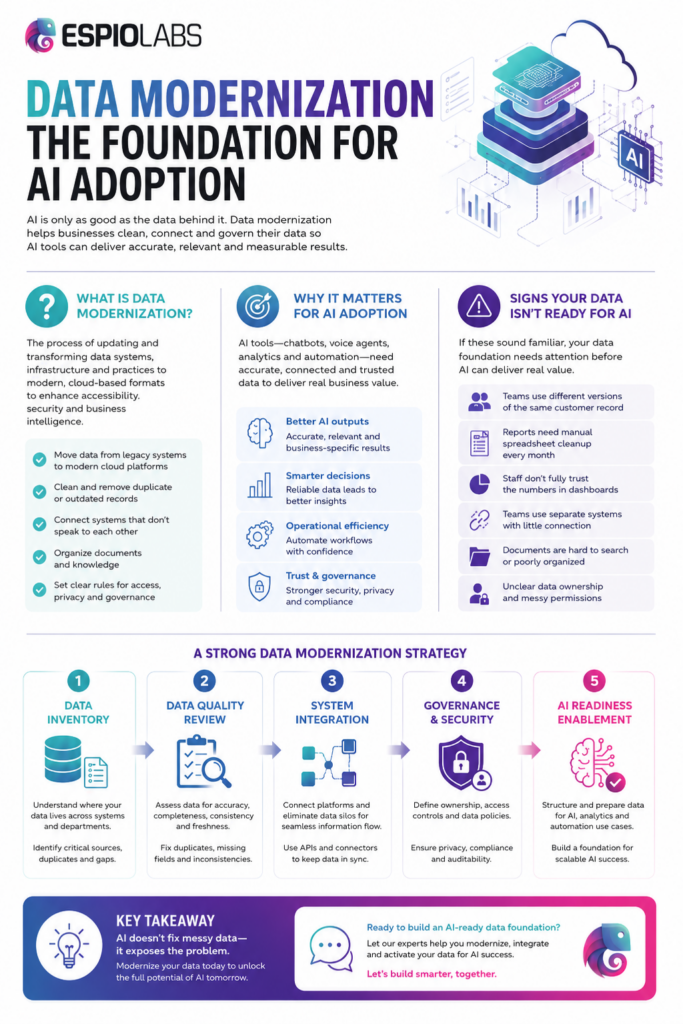
IBM defines data modernization as “the process of updating and transforming data systems, infrastructure and practices to modern, cloud-based formats to enhance accessibility, security and business intelligence”. The goal is to move away from scattered, outdated, or unreliable data systems so teams can use information more effectively across reporting, workflow automation, analytics, and AI tools.
- This may involve moving data from legacy software into a modern cloud platform.
- Or it could mean cleaning duplicate records, connecting systems that do not currently speak to each other, organizing internal documents, or setting clearer rules for who can access sensitive information.
At a practical level, data modernization helps answer questions like:
- Where does our business data live?
- Which systems are creating duplicate or conflicting information?
- Can employees find the information they need?
- Can our data support automation or AI?
- Are permissions, privacy, and governance controls clear enough?
Why this matters: A chatbot, voice agent, reporting assistant, or custom AI solution needs accurate business context. If the data behind the tool is incomplete or unreliable, the output will be limited too.
Why Data Modernization Matters for AI Adoption
AI adoption works best when the business has a strong data foundation. A company can invest in advanced AI tools, but those tools still need access to clean, connected, reliable and trusted information.
Think about a customer support chatbot. If it pulls from outdated FAQs, scattered policy documents, and inconsistent product information, it may give weak or inaccurate answers. A sales assistant connected to messy CRM data may suggest the wrong next step. A voice agent that captures call details may create more admin work if there is no structured workflow for where those notes should go.
The same problem applies to analytics and automation. Predictive models need reliable historical data. Workflow automation needs consistent fields, rules, and triggers. Internal AI assistants need permissioned access to the right files, records, and knowledge sources.
AI does not fix messy data. In many cases, it exposes the problem faster.
This is why data modernization should be part of any serious AI adoption plan. It helps businesses understand what data they have, where gaps exist, how information flows across departments, and what needs to change before AI can deliver real value.
Frameworks like the NIST AI Risk Management Framework also reinforce the need for trust, governance, transparency, and risk planning when AI systems are used. Those ideas are hard to apply if the business does not know where its data lives or who controls it.
Common Signs Your Data Is Not Ready for AI
Many businesses do not realize they have a data readiness issue until they start testing AI. The warning signs often appear in everyday operations before an AI project begins.
Your data may not be ready for AI if:
- teams use different versions of the same customer record
- reports need manual spreadsheet cleanup every month
- staff do not fully trust the numbers in dashboards
- teams all use separate systems with little connection between them
Other common signs include:
- documents that are hard to search
- inconsistent naming conventions
- unclear data ownership
- old systems that cannot integrate with newer tools
- permissions that have grown messy over time.
If an AI pilot requires hours of manual cleanup before it can produce anything useful, that is another signal that the data foundation needs attention.
This does not mean a business needs to pause every AI idea until a massive data project is complete. It means the business needs to understand which data problems are blocking the specific AI use cases it wants to pursue.
If your team is exploring AI but your data still lives across spreadsheets, shared drives, disconnected platforms, or legacy systems, AI readiness should be part of the conversation before tools are selected or built. Explore our custom AI solutions or reach out to our AI experts.
What a Data Modernization Strategy Should Include
A strong data modernization strategy does not start with technology alone. It starts with a clear view of the business problem, the data involved, and the AI or automation outcomes the company wants to support.
Data Inventory
The first step is to understand where the data lives. This may include CRM records, finance systems, HR platforms, e-commerce tools, booking software, shared drives, customer support tickets, project management tools, and internal documentation.
A data inventory helps reveal which systems matter most, which departments rely on them, and where information gets duplicated or lost. It also helps identify which data sources could support future AI tools.
Data Quality Review
AI tools depend on quality inputs. If records are missing, duplicated, outdated, or formatted inconsistently, the system may produce unreliable results.
A data quality review looks at issues such as duplicate contacts, missing customer fields, inconsistent product names, outdated documents, and reports that produce conflicting numbers. These issues may seem small, but they can limit what AI can do.
System Integration Planning
Most businesses use several platforms to run daily operations. The problem is that these platforms are often disconnected.
For AI and workflow automation to work well, systems may need to share information more cleanly. A CRM might need to connect with a marketing platform. A support system might need to send structured summaries to a project management tool. A voice agent might need to create follow-up tasks after a customer call.
System integration planning helps define which connections matter, which workflows need automation, and where human review should remain part of the process.
Governance and Permissions
Data modernization is not just about access. It is about the right access.
Before introducing AI tools, businesses need clear rules around sensitive information, customer data, employee records, financial data, and internal documents. Not every AI assistant should be able to access every file. Not every user should see the same information.
Governance helps define who owns the data, who can use it, how long it should be kept, and how it should be protected.
AI Use Case Mapping
A data modernization strategy should connect directly to practical AI opportunities. This could include an AI chatbot trained on internal documentation, an AI receptionist that captures structured call notes, an internal assistant for employee questions, automated reporting, predictive analytics, or a RAG-based knowledge system.
This is where strategy becomes useful. The business can prioritize the data work that supports the AI use cases with the clearest value.
A strong AI strategy consultation starts with understanding your data, systems, workflows, and business goals before building custom tools, chatbots, agents, or automation workflows. Book your AI strategy consultation.
A Simple Data Modernization Framework for AI Readiness
A practical data modernization framework can help businesses move from scattered data to AI-ready workflows. The framework does not need to be overly complicated. It should give teams a clear way to assess, clean, connect, govern, and activate their data.
| Stage | What It Means | Why It Matters for AI |
| Discover | Map systems, data sources, owners, and pain points | Shows what data AI can access |
| Clean | Fix duplicates, missing fields, outdated records, and inconsistent formats | Improves AI output quality |
| Connect | Integrate key systems and workflows | Lets AI support real business processes |
| Govern | Set rules for access, privacy, security, and usage | Reduces AI risk |
| Activate | Use data for dashboards, automation, chatbots, and custom AI tools | Turns data work into business value |
This framework works because it keeps the focus on business use. The point is not to modernize data for the sake of it. The point is to help teams make better decisions, reduce manual work, and give AI systems better information to work with.
Cloud platforms and modern data tools can play a role here. For example, Google Cloud’s data platform discusses bringing structured and unstructured data together with governance, analytics, and AI capabilities. The broader lesson is useful for any business: AI becomes more useful when data is easier to find, manage, protect, and apply.
Data Modernization vs. Digital Transformation
Data modernization and digital transformation are related, but they are not the same thing.
Digital transformation is broader. It may involve changing business processes, launching digital products, improving customer experience, replacing old software, or rethinking how teams work.
Data modernization is more specific. It focuses on making data cleaner, more connected, more secure, and more usable.
| Area | Data Modernization | Digital Transformation |
| Focus | Data systems, quality, access, and governance | Business processes, products, tools, and customer experience |
| Main goal | Make data easier to use | Improve how the business operates |
| AI connection | Prepares data for AI tools | May include AI as part of a wider change |
| Example | Connecting CRM, documents, and reporting data | Launching a new digital customer portal |
A business can modernize data as part of a larger digital transformation plan. It can also start smaller by modernizing the data needed for one practical AI use case.
How Data Modernization Supports AI Tools and Automation
For many businesses, the first AI opportunity is not a large enterprise platform. It may be a focused AI assistant, chatbot, reporting workflow, or automation tool that solves a clear operational problem.
Data modernization helps make those projects more reliable:
- An AI chatbot needs accurate knowledge sources.
- A voice agent needs structured intake fields and follow-up rules.
- An AI copilot needs permissioned access to useful business data.
- A RAG system needs organized documents and searchable knowledge.
- Workflow automation needs clean inputs, triggers, and handoffs.
Without those pieces, AI projects often become manual work in disguise. Staff may need to clean files before uploading them, double-check every response, or move information between systems by hand. That limits the value of the tool.
With better data, AI tools can support real workflows:
- A sales team can use AI to summarize CRM activity and suggest follow-ups.
- A support team can use AI to classify tickets and draft responses.
- A leadership team can use AI-assisted reporting to understand trends faster.
- A service business can use a voice agent to capture call details and push structured notes into the right workflow.
This is where custom AI solutions become more useful than generic tools. The right solution should reflect the company’s systems, processes, data quality, and business goals.
When Should a Business Start Data Modernization?
A business should consider data modernization before launching AI tools, building an internal chatbot, using a voice agent, automating customer workflows, or creating dashboards for decision-making.
It is also worth reviewing when a company is replacing legacy software, connecting CRM and finance systems, moving data to the cloud, or trying to reduce manual reporting. Repeated reporting errors, low trust in dashboards, and weak AI pilot results are all signs that the timing may be right.
The best starting point is usually not a huge transformation plan. It is a focused assessment of the data needed for a clear business use case.
For example, if the goal is to build an internal AI assistant, the business can start by reviewing the documents, permissions, and knowledge sources that assistant would need. If the goal is workflow automation, the team can start by reviewing the systems, fields, and handoffs involved in that process.
This keeps data modernization practical and tied to value.
Before You Build AI, Fix the Data Foundation
AI adoption works best when businesses understand the data behind the tools they want to build. A chatbot, voice agent, workflow automation system, or internal AI assistant can only be useful if it has access to reliable information and a clear business process.
Data modernization helps create that foundation. It gives teams a clearer view of where data lives, how it is managed, who can access it, and how it can support practical AI use cases.
For companies exploring AI chatbots, voice agents, workflow automation, predictive analytics, or custom AI solutions, this groundwork can make the difference between a limited experiment and a useful business tool.
If your business is planning to adopt AI, data modernization is one of the best places to start. EspioLabs can help you assess your current data environment, identify AI-ready use cases, and build a practical roadmap for custom AI solutions.
To explore what this could look like for your business, speak with EspioLabs.